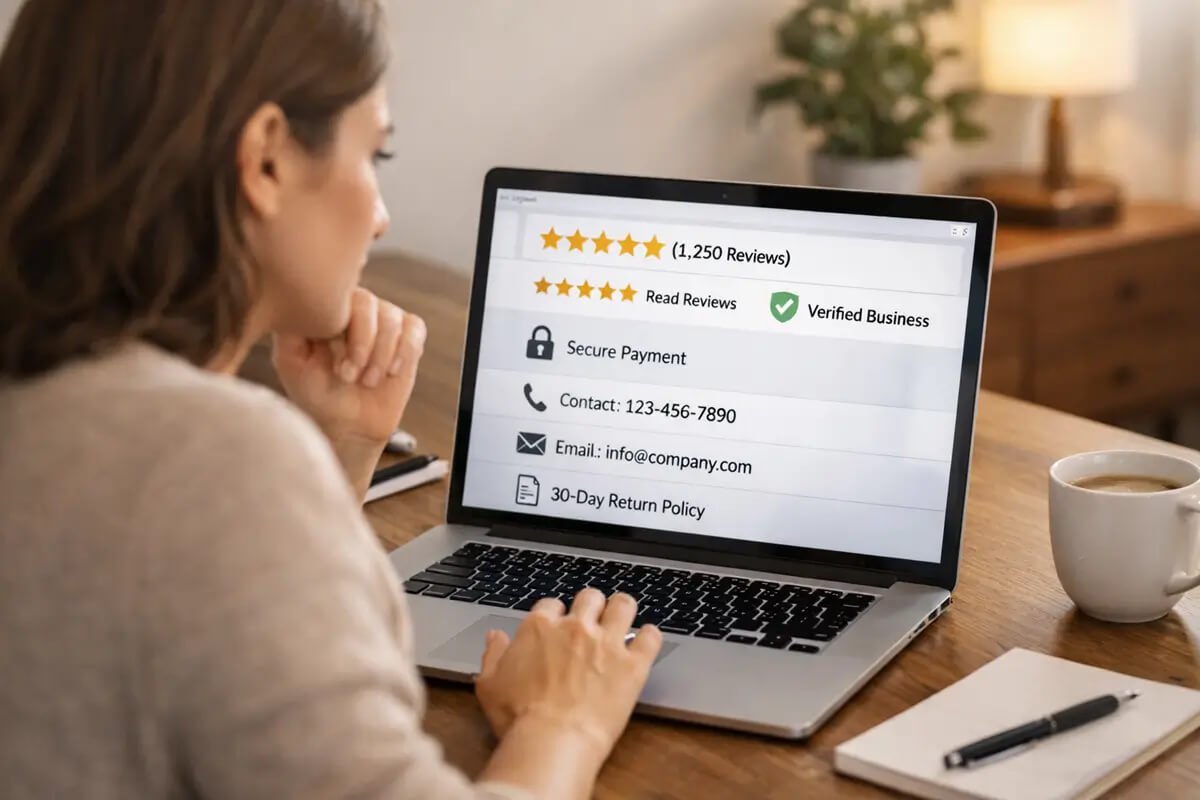

Some businesses are genuine, reliable, and easy to deal with. Others look good at first, then become a headache the moment you pay. That is why it helps to slow down and check a few things before you buy.
If you want the short answer, here it is: to trust a business online before buying, check who they are, read reviews properly, look at their policies, confirm their payment methods, and see how they deal with customers when something goes wrong.
That sounds simple, but most people do not do it properly. They see a nice website, a discount, or a few five-star reviews and assume everything is fine. Sometimes it is. Sometimes it is not.
This guide will show you how to check a business step by step without overthinking it. You do not need to investigate every company for an hour. You just need to know what to look for.
Start with the business itself
Before you read reviews or compare ratings, look at the business on its own.
Ask a basic question first: does this look like a real business, or just a page trying to make a sale?
That means checking the obvious things people often skip.
Look for a clear business identity
A proper business should make it easy to see:
- who they are
- what they sell
- who the service is for
- how to contact them
- what happens if there is a problem
If you land on a site and still cannot clearly tell what the business does, that is not a great sign.
A trustworthy business usually explains itself in a simple way. You should not have to dig through five pages to understand what they offer.
Check the contact page
This is one of the easiest checks, and it tells you a lot.
Look for:
- a real email address
- a support page
- a phone number if relevant
- a physical address if relevant
- clear contact options for customers
If there is no proper contact page at all, stop and think. Some online businesses work mostly through email or chat, and that is fine. But if it feels hard to reach them before you buy, it may be worse after you pay.
Read the About page if they have one
A lot of people skip the About page, but it can be useful.
You are not looking for a dramatic brand story. You are looking for signs that the business is real, clear, and consistent. If the wording feels vague, copied, or full of empty claims, that is worth noticing.
Good businesses usually sound like they know what they do. They do not need to oversell everything.
Check whether the website feels honest
This part is not about fancy design. A business can have a simple site and still be trustworthy.
What you are checking is whether the website feels maintained, clear, and believable.
Look for missing or sloppy details
Watch for things like:
- broken pages
- missing policy pages
- unclear pricing
- copied product descriptions
- poor grammar in key places
- pages that feel rushed or incomplete
One typo is not a problem. A few rough edges are normal. But if the whole site feels careless, that can reflect how the business works too.
Be careful with big claims
If a business says things like:
- best in the world
- guaranteed results
- trusted by everyone
- lowest price anywhere
- risk-free in every situation
take a step back.
A trustworthy business usually explains its offer clearly. It does not need to sound like an ad from start to finish.
Read reviews, but read them properly
This is where many people get it wrong.
They look at the star rating, maybe scan one or two comments, then make a decision. That is not enough.
If you want to know how to check if a business is trustworthy online, reviews can help, but only when you read them the right way.
Do not focus only on the average rating
A business with a high rating can still be a bad choice. A business with a mixed rating can still be perfectly fine.
The number matters less than the pattern.
Ask yourself:
- what do people keep mentioning?
- are there repeated complaints?
- do reviews sound real?
- are recent reviews better or worse than older ones?
- does the business reply to complaints?
That gives you a much better picture than a simple star score.
Look for specific reviews
Real reviews usually include real details.
They might mention:
- what the customer bought
- how long delivery took
- whether support replied
- whether a refund was given
- what went wrong and how it was handled
Vague reviews are less useful. If every review sounds like “Amazing service, highly recommended” with no detail, be careful.
That does not prove anything by itself, but it should not be the only thing you rely on.
Watch for review patterns
This matters more than any single review.
Warning signs
- lots of reviews posted in a short time
- many reviews using similar wording
- repeated complaints about refunds
- repeated complaints about poor support
- reviews saying orders never arrived
- reviews that sound too generic
- no reply from the business when customers complain
Better signs
- reviews mention real situations
- the feedback is mixed but believable
- customers mention problems being fixed
- the business replies in a calm way
- recent reviews still sound solid
A trustworthy business does not need perfect reviews. It just needs a believable pattern and a decent way of handling problems.
Check how the business handles complaints
This is one of the best trust checks, and people often ignore it.
Anyone can look good when everything goes smoothly. The real test is what happens when something goes wrong.
Read the negative reviews carefully
Do not just count how many bad reviews there are. Read them.
Try to work out:
- what the actual complaint is
- whether it sounds reasonable
- whether the issue was solved
- whether the business replied properly
Sometimes the negative review says more about the customer than the company. Sometimes it clearly points to a real business problem. You have to read it, not just react to it.
Look at the tone of the reply
If the business replies, the tone matters.
A good reply usually sounds:
- calm
- respectful
- clear
- willing to help
- focused on solving the issue
A bad reply often sounds:
- rude
- defensive
- dismissive
- copied and pasted
- more interested in winning the argument than fixing the issue
If a business handles criticism badly in public, there is a fair chance it will be difficult in private too.
Read the policy pages before you pay
A lot of online buyers ignore the boring pages, then regret it later.
If you want to verify a business before buying, the policy pages matter more than people think.
Check the refund policy
This is one of the first things to read.
Look for:
- whether refunds are offered
- how long you have to request one
- whether returns are accepted
- who pays for return shipping
- whether there are exclusions or restocking fees
A strict refund policy is not always a bad sign. But a confusing one is.
If the policy is vague, hard to find, or written in a way that leaves everything open to interpretation, be cautious.
Check delivery or service terms
If you are buying a product, read the shipping terms.
If you are hiring a service, read what happens after payment.
You want to know:
- when delivery starts
- how long it may take
- what happens if there is a delay
- whether there is any support after purchase
A decent business usually explains this clearly. A weak one leaves everything fuzzy until the money is gone.
Check how they ask you to pay
Payment method is a trust signal too.
A proper business usually gives you secure, familiar ways to pay. It should not feel risky or strange.
Better signs
- secure checkout
- card payment through known providers
- trusted payment gateways
- clear currency and pricing
- proper order confirmation
Red flags
Be careful if the business pushes you to:
- pay by bank transfer only
- pay through a personal account
- use crypto with no buyer protection
- complete payment outside the normal checkout process
- rush into paying before you can review the terms
That does not always mean the business is fake. But it does raise the risk.
Search outside the website
Do not rely only on what the company says about itself.
If you are researching a business before making a purchase, look beyond its own site.
Search the business name with extra terms
Try searching the business name with words like:
- reviews
- complaints
- refund
- scam
- support
- customer service
This helps you see whether the same issues keep showing up in more than one place.
You are not looking for a spotless reputation. That rarely exists. You are looking for consistency.
Check whether details match across the web
Basic details should line up.
That includes:
- business name
- website address
- customer support details
- product or service focus
- public brand identity
If the business appears under different names in different places, or key details do not match, take that seriously.
Know the difference between normal problems and real red flags
This matters because not every complaint means you should walk away.
Normal issues that may not be deal-breakers
These can happen even with good businesses:
- a delayed delivery during a busy period
- a few unhappy customers
- one poor support interaction
- mixed reviews on minor issues
- complaints about price rather than quality
Look at the full picture.
Bigger warning signs
These are more serious:
- customers saying they never received the product
- repeated complaints about refunds not being honoured
- no real customer support
- no clear business identity
- pressure to pay through risky methods
- aggressive replies to complaints
- unrealistic promises with no proof
- policy pages that seem written to avoid responsibility
If several of these show up together, that is usually enough reason to leave it alone.
A quick way to check a business before buying
If you do not want to overcomplicate things, use this short checklist.
The fast trust checklist
- Do I know who this business is?
- Can I contact them easily?
- Do the reviews sound real?
- Are the complaints minor or serious?
- Does the business reply properly?
- Is the refund policy clear?
- Does the payment method feel safe?
- Do the business details look consistent elsewhere online?
If too many answers are no, that is your answer.
Common mistakes people make
Trusting design too much
A nice website helps, but it proves very little. Some poor businesses look polished. Some solid businesses look plain.
Looking only at five-star reviews
The best reviews are not always the most positive ones. They are the most useful ones.
Ignoring policy pages
People skip them because they look boring. Then they are shocked when the refund process is difficult.
Buying too fast because of urgency
Countdown timers, “last chance” banners, and heavy discount language can push people into quick decisions. If a business is worth buying from, taking ten extra minutes to check it should not ruin the deal.
What a trustworthy business usually looks like
There is no perfect formula, but most trustworthy online businesses have a few things in common.
They are usually clear about who they are. Their site explains what they do without trying too hard. Their reviews sound like real customer experiences. Their policy pages are easy to find. Their payment process feels normal and secure. And when customers raise issues, they do not hide.
That does not mean they are perfect. It means they look real, accountable, and stable.
FAQ
How do I know if an online business is legit?
Check the basics first: business identity, contact details, policy pages, customer reviews, and payment security. Then search the business name outside its own website to see whether the public reputation looks consistent.
How can I check if a business is trustworthy online?
Read reviews for patterns, not just ratings. Look at complaints, refund issues, delivery problems, and how the business replies. Also check if the website clearly explains who they are and how support works.
Are bad reviews always a deal-breaker?
No. Most real businesses have some bad reviews. What matters is whether the complaints are serious, repeated, and unresolved.
What is the biggest red flag before buying online?
Repeated complaints about missing orders, refund problems, no customer support, and unclear business details are some of the biggest red flags.
Final word
If you want to trust a business online before buying, do not look for one magic sign. Look for a pattern.
Check the business itself. Read the reviews properly. Read the policy pages. Make sure the payment process feels safe. Search beyond the website.
Most of the time, a good business leaves enough signs to make you feel comfortable. A bad one usually leaves clues too. The trick is not to ignore them.
Comments (0)