
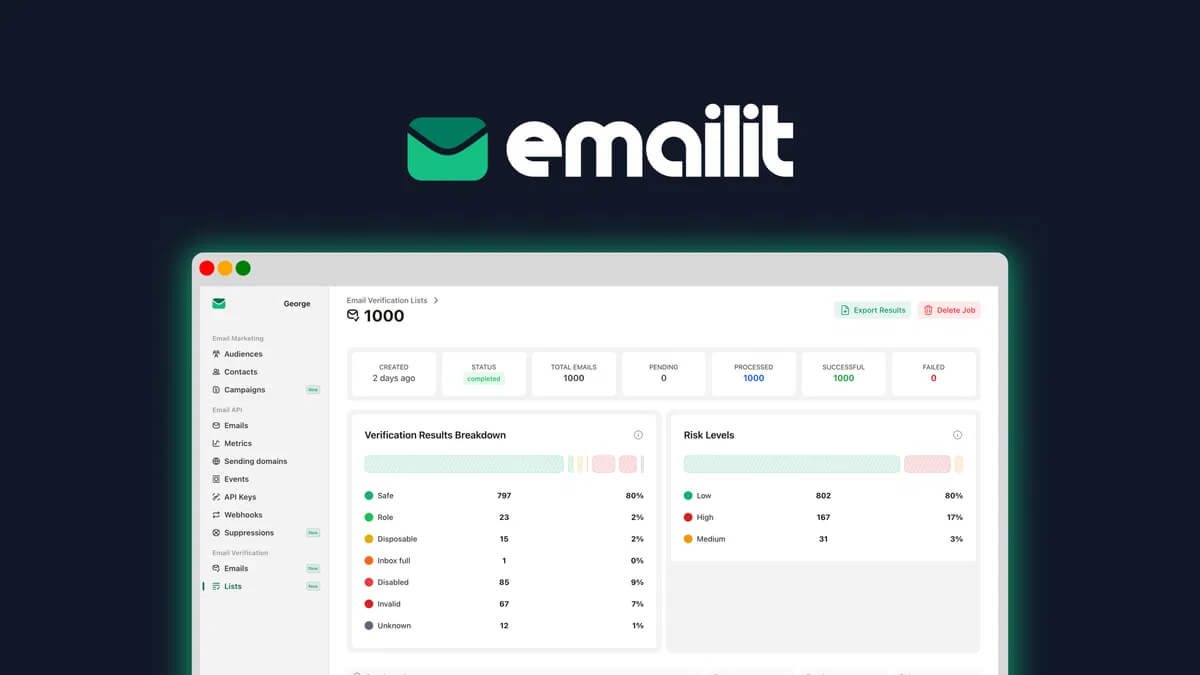

If you are looking for an email platform that supports both SMTP and API without locking you into a standard monthly sending subscription, Emailit is worth a closer look. It is built for transactional email, campaigns, templates, and developer-friendly integrations, but it also comes with a few limits you should know before buying.
In this review, I will walk through what Emailit offers, how its pricing works, what stands out, where to be careful, and who it makes the most sense for.
Quick Verdict
What Emailit is
Emailit is an email delivery platform for transactional emails and campaigns. It supports SMTP and REST API sending, uses a credit-based pricing system, and includes extra tools like templates, campaign sending, event tracking, contacts, and webhooks.
That makes it more than a basic SMTP relay. At the same time, it is not the kind of platform you should describe as a full automation suite yet, because its Automations add-on is listed separately and marked as coming in 2026.
Key features
SMTP and REST API
This is the core of the product. If you need to send password resets, order confirmations, system alerts, or app emails, Emailit supports both SMTP and API delivery. That gives it a practical fit for developers and businesses that want flexibility instead of being tied to one sending method.
Templates
Emailit officially offers reusable templates with variables like {{name}}. Templates can be built with an HTML editor, a rich-text editor, or a drag-and-drop builder. The platform also supports versioning and publishing, which is useful if you want to update designs without breaking live sends.
Contacts, events, and webhooks
The newer API updates add more control around contacts, event logs, and webhook endpoints. Contacts can store names, email addresses, custom fields, and audience subscriptions. Events give read-only activity tracking, while webhooks can push real-time callbacks for delivery, bounce, and related actions.
Campaigns and analytics
Emailit also supports campaign sending. According to public product updates, campaign features include audience selection, scheduling, preview tools, variables, and campaign statistics. Tracking options depend on domain setup and enabled tracking.
Sending domains and authentication
As with any serious email sending setup, domain configuration matters. Public guides on AppSumo and Emailit documentation show that sending domain creation, credentials, and SMTP setup are part of the product workflow. That is a good sign for users who care about proper sender setup instead of just blasting emails from day one.
Pricing and credits
Emailit uses a credit model. That is one of the main reasons it stands out. Instead of paying a standard monthly plan just to keep the account active, you buy credits and spend them based on what you send.
Credits do not expire. Emailit also states that there is no free tier anymore. Instead, it offers a 30-day money-back guarantee if you are not satisfied after sending up to 1,000 emails.
Optional add-ons
- Automations: $25/month, listed as coming in 2026
- Data Retention: $50/month
- Dedicated IP: $300/year
What Emailit does well
- It keeps the core pricing simple. You buy credits and use them when needed.
- It supports both SMTP and API, which makes it useful for both developers and non-developer business use cases.
- It has grown beyond basic sending. Templates, contacts, event logs, webhooks, and campaign tools make the platform more capable than a bare-bones relay service.
- Templates support reusable designs and variables, which is useful if you send repeated email types.
- AppSumo user summary highlights reliable delivery, interface usability, and responsive support as common positives, though that should still be taken as marketplace feedback, not absolute proof.
Where to be careful
No free tier
Some buyers expect a small free plan for testing. Emailit no longer offers that. The paid entry point is still low, but it is not free.
Early sending limits
Emailit states that sending starts at 2 messages per second and up to 5,000 messages per day. Those limits may increase based on sender history and reputation, but a fresh account should not expect enterprise-scale throughput on day one.
Automation is not the main selling point yet
If your main priority is sophisticated workflow automation, you should read carefully before buying. Emailit publicly lists Automations as a separate add-on and marks it as coming in 2026.
Public review sentiment is mixed
Trustpilot feedback for Emailit is notably polarized. Some reviewers praise the service and setup experience, while others raise serious complaints about deliverability, suspension, and review authenticity. That does not automatically prove the platform is bad, but it does mean you should not treat public review scores as the whole story. Test the service against your own use case.
Who Emailit is best for
Quick comparison view
This is not a full head-to-head against every competitor. It is a simple buying-angle view based on Emailit’s publicly visible positioning.
Rating breakdown
This score reflects the public feature set and pricing model, balanced against the lack of a free tier, early sending limits, and mixed public review sentiment.
Final verdict
Emailit looks strongest as a flexible sending platform for people who want SMTP and API support without committing to a typical monthly email subscription just to stay active. The credit model is simple. The feature set is broader than basic sending. Templates, campaigns, contacts, events, and webhooks give it real utility.
Still, this is not the kind of product I would oversell. If you need advanced automation right now, or if your buying decision depends heavily on polished public reputation, you should test carefully and compare alternatives first.
Bottom line: Emailit is worth considering if you want practical email sending tools, developer-friendly features, and a credit-based cost model. It is a better fit for controlled, smart buyers than for people chasing hype.
FAQ
Does Emailit have a monthly subscription?
For core sending, Emailit says there are no required monthly subscription fees. You buy credits and use them as needed. Some add-ons, however, are priced monthly or yearly.
Is Emailit good for transactional email?
Yes, based on the public product setup, it is clearly positioned for transactional sending through SMTP and API.
Does Emailit support templates?
Yes. Emailit officially documents templates with variables, multiple editors, versioning, publishing, and API support.
Is Emailit fully trust-proof based on review sites?
No. Public review sentiment is mixed. Trustpilot feedback is polarized, so it is better to use public reviews as one signal, not your only decision factor.
What is the cheapest entry point?
The public pricing page shows the Starter bundle at $20 for 100,000 credits.
Sources

Comments (0)