
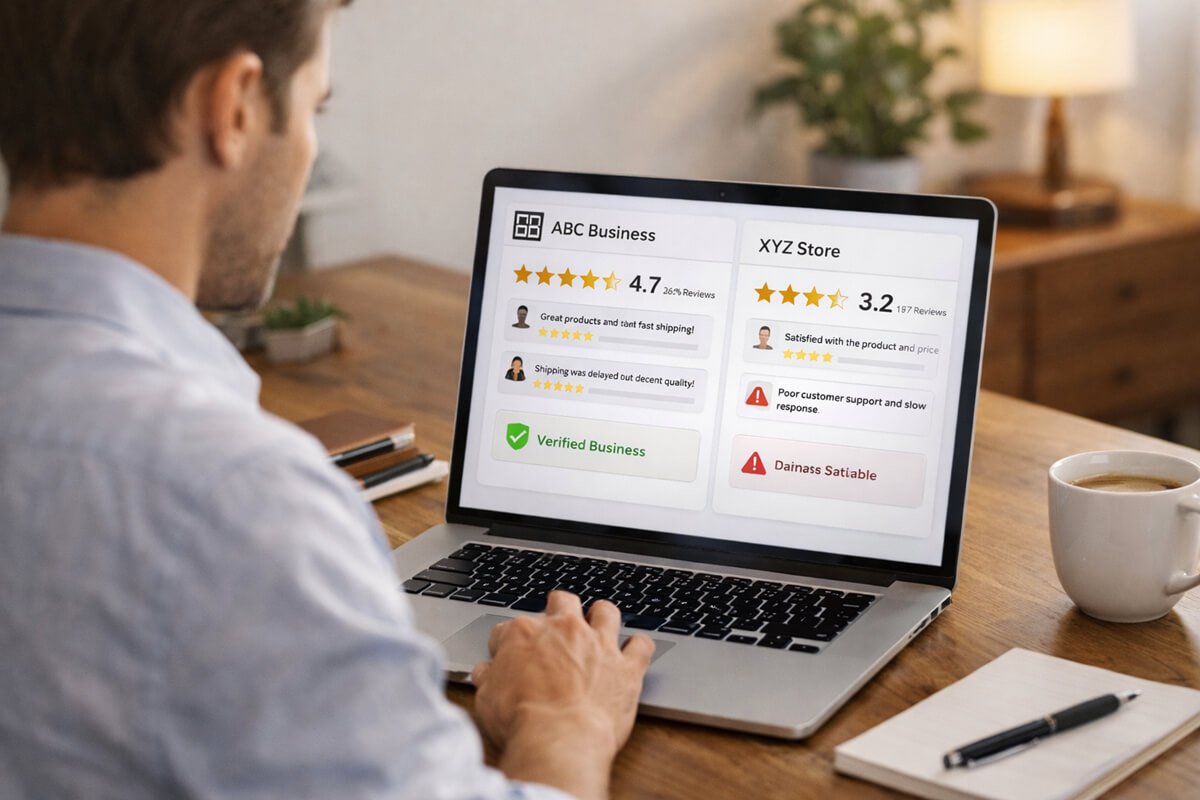

If you want to compare businesses properly, do not look at the star rating alone.
Check the rating, the number of reviews, what people keep mentioning, how recent the feedback is, and how the business responds when something goes wrong.
That gives you a much better picture.
A lot of people choose too fast. They see 4.8 stars, read one or two reviews, and make a decision.
That is usually not enough.
Reviews and ratings can help a lot, but only if you read them the right way.
Why reviews and ratings matter
A business can say anything about itself.
Its website will always try to look good. Its ads will do the same.
Reviews are different.
They show what customers actually experienced, not just what the business wants to highlight.
That does not mean every review is fair or accurate. But when many reviews point in the same direction, they can tell you a lot.
They can help you spot:
- strong service
- repeated complaints
- hidden problems
- weak support
- common strengths
That is why reviews and ratings are useful when you are comparing similar businesses.
Ratings and reviews are not the same
People often treat them like the same thing.
They are not.
A rating gives you a quick summary. Usually that means stars, often from 1 to 5.
A review gives you the detail behind the score.
That detail matters more.
A business with 4.9 stars from 8 people is not automatically better than one with 4.6 stars from 600 people.
The second one may give you a much clearer picture because more customers have weighed in.
Start with the overall rating, but do not stop there
The average rating is the first thing most people notice.
That is fine. It is a useful starting point.
But it should never be your final decision point.
Ask:
- Is the rating clearly lower than similar businesses?
- Is it based on enough reviews to mean something?
- Does it still hold up when you read the written feedback?
A rating only matters when there is enough real feedback behind it.
Check how many reviews the business has
This part is easy to miss.
A business with a perfect score and very few reviews may not tell you much.
A business with a slightly lower score but a large number of reviews is often easier to trust because the rating is based on more customer experiences.
That does not mean bigger is always better.
It means the sample is usually stronger.
If two businesses are close in rating, the one with far more believable feedback often gives you a safer signal.
Read recent reviews first
Businesses change.
A place that had poor service last year may be much better now. A business with a strong reputation two years ago may have slipped badly.
That is why recent reviews matter.
Start with the newest feedback. Then move backward if needed.
Look for patterns from the last few months.
Pay attention to whether people are saying the same things now that they were saying before.
That helps you see whether the business is improving, stable, or getting worse.
Look for repeated patterns, not isolated opinions
This is one of the most useful habits you can build.
Do not let one very positive review impress you too much. Do not let one angry review scare you too fast either.
Look for repetition.
If many people mention the same issue, it probably matters.
Common patterns worth noting:
- long wait times
- rude staff
- poor communication
- refund problems
- hidden charges
- strong product quality
- quick service
- helpful support
Patterns tell the real story.
Single reviews often do not.
Pay attention to what matters most to you
Not every buyer cares about the same thing.
That is why two businesses with similar ratings can still feel very different.
For example:
- one restaurant may have better food but slower service
- one plumber may be more reliable but more expensive
- one online store may ship quickly but handle returns poorly
So before you compare businesses, decide what matters most to you.
That might be:
- price
- speed
- product quality
- friendliness
- return process
- communication
- location
Once you know that, reviews become easier to use.
You stop reading everything equally. You start filtering for what actually matters to your decision.
Watch for fake, weak, or unfair reviews
Not all reviews deserve the same weight.
Some are fake. Some are too vague to help. Some are written by people who had a very unusual experience.
A few warning signs:
- many short reviews posted close together
- repeated wording across different reviews
- reviews with no real detail
- profiles that only leave extreme ratings
- sudden bursts of praise that feel unnatural
That does not prove the reviews are fake.
But it should make you more careful.
The most useful reviews usually sound balanced. They mention a real situation. They explain what happened.
Check how the business responds
A business cannot control every complaint.
But it can control how it responds.
That makes review responses worth reading.
A good response usually feels:
- calm
- respectful
- clear
- willing to solve the issue
A poor response often feels:
- defensive
- rude
- dismissive
- copied and pasted
This matters because it shows what kind of business you may be dealing with after you spend money.
If they handle public criticism badly, private support may not be much better.
Compare businesses side by side
If you are deciding between two or three options, do not keep everything in your head.
Write down the basics.
Keep it simple.
Compare:
- average rating
- number of reviews
- main positives
- common complaints
- price level
- response quality
- recent review trend
This helps you make a clearer decision.
It also stops you from being swayed by one flashy detail.
Common mistakes people make
Looking only at the star rating
This is the biggest one.
The rating matters, but it is only the first layer.
Trusting very small review counts
A near-perfect score based on a handful of reviews does not tell you much.
Ignoring recent feedback
Old reviews can help, but they do not always reflect the current business.
Taking every review at face value
Some reviews are fake, exaggerated, or incomplete.
Ignoring owner responses
How a business handles complaints says a lot.
A quick checklist before you choose
Before you pick one business over another, ask:
- Which one has the more reliable review count?
- Which one has stronger recent feedback?
- What complaints show up repeatedly?
- What strengths show up repeatedly?
- Which business replies better to criticism?
- Which one matches what matters most to me?
If one option clearly looks stronger across most of those points, your decision gets much easier.
FAQ
Should I trust a business with a perfect rating?
Not automatically. A perfect rating with very few reviews may not mean much. Look at the review count, the review quality, and how recent the feedback is.
Are negative reviews always a bad sign?
No. A few negative reviews can actually make the overall feedback look more believable. What matters is whether the same complaints keep showing up.
What is more important: rating or review count?
You need both. A high rating matters more when it is backed by a solid number of believable reviews.
How do I compare two businesses with the same rating?
Look at recent feedback, repeated complaints, review count, and how each business responds to customers. That usually shows the difference.
Final word
If you want to compare businesses well, do not chase the highest star rating and stop there.
Read the feedback properly.
Look for patterns. Check recent reviews. Notice repeated complaints. See how the business responds.
That is usually enough to help you make a smarter choice.
Comments (0)